
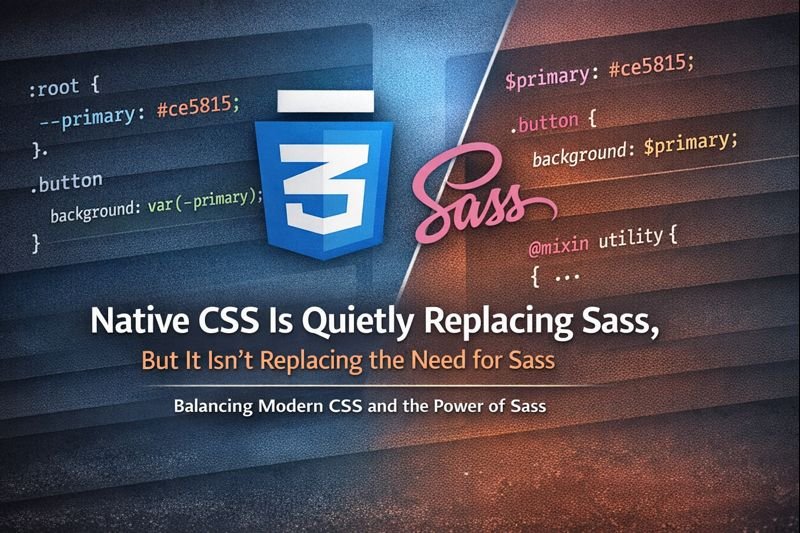
TL;DR Modern CSS has absorbed most of what made Sass essential. Variables, nesting, cascade control, container queries, and runtime theming now live natively in the language. That doesn’t make Sass obsolete. It changes its role. Sass moves from “required infrastructure” to “optional build-time power tool.”
For over a decade, Sass was not just helpful. It was necessary.
It gave us variables, structure, mixins, and logic in a language that had none. If you were building anything serious, a preprocessor was part of the stack by default. You didn’t debate it. You installed it.
But CSS has grown up.
Features that once required a preprocessor now live natively in the language. If you have not been tracking these changes, start with 2026 CSS Features You Must Know. It explains why this shift is real, not theoretical.
Modern CSS now includes:
- Native variables with runtime power
- Nesting
@layerfor cascade control@scopefor contextual styling- Container queries
:has()for parent-aware logic- Advanced color functions like
oklch()andcolor-mix() - Math functions and composable custom properties
These are not cosmetic upgrades. They remove entire categories of hacks and workarounds that preprocessors existed to solve.
You no longer need Sass to write serious CSS.
That does not mean Sass is dead. It means its role has changed.
Variables: Compile-Time vs Runtime
Sass variables are resolved at build time. Once compiled, the value is frozen in the output:
$primary: #ce5815;
.button {
background: $primary;
}
Native CSS variables live at runtime and can be changed without rebuilding:
:root {
--primary: #ce5815;
}
.button {
background: var(--primary);
}
You can now swap an entire design system in real time:
[data-theme="dark"] {
--primary: #44b0b9;
}
This is not a small difference. It changes architecture. CSS moved from static output to a runtime system.
Nesting Without a Preprocessor
What once required Sass now works natively:
.card {
padding: 1rem;
.title {
font-weight: 600;
}
&:hover {
box-shadow: 0 0 0 1px #000;
}
}
The syntax feels familiar, but this is real CSS. There is no compilation step. No abstraction layer. No indirection.
From Media Queries to Container Queries
Traditional responsive design centered on viewport breakpoints:
.card {
width: 100%;
@media (min-width: 768px) {
width: 50%;
}
}
Modern CSS lets components respond to their container instead:
.card {
width: 100%;
}
@container (min-width: 400px) {
.card {
width: 50%;
}
}
This moves layout logic from “page thinking” to “component thinking.” No mixins. No helpers. Just CSS that understands context.
Runtime Theming Changes Everything
With Sass, multi-theme systems often look like this:
@mixin theme($bg, $text) {
background: $bg;
color: $text;
}
.card {
@include theme(#fff, #111);
}
.dark .card {
@include theme(#0b0f1a, #e5e7eb);
}
With native CSS:
.card {
background: var(--bg);
color: var(--text);
}
:root {
--bg: #ffffff;
--text: #111111;
}
[data-theme="dark"] {
--bg: #0b0f1a;
--text: #e5e7eb;
}
No duplication. No recompilation. No threading theme parameters through every component.
That is not a syntax improvement. It is a systems-level shift.
Where Sass Still Wins
Sass is not obsolete. It is simply no longer foundational.
It still shines where native CSS intentionally does not operate:
- Generating large token matrices at build time
- Creating utility classes from design tokens
- Abstracting complex repeated patterns with mixins
- Supporting legacy browsers and pipelines
- Maintaining large, established Sass codebases
Example: generating utilities from a token map:
$spaces: (
sm: 4px,
md: 8px,
lg: 16px,
);
@each $key, $value in $spaces {
.m-#{$key} {
margin: $value;
}
}
This kind of compile-time generation is still a sweet spot for Sass.
This Is Evolution, Not Replacement
This is not “Sass vs CSS.” It is how front-end evolves:
- Tools rise to compensate for missing language power.
- Languages evolve.
- The tools either adapt or become optional.
Sass did not fail. CSS grew.
In 2026, the healthiest mindset is simple:
Write native CSS first. Add preprocessors when they earn their place.
Preprocessors are not disappearing. They are just no longer the starting point.
And that is a quiet revolution in how we build the web.
Leave a Reply