
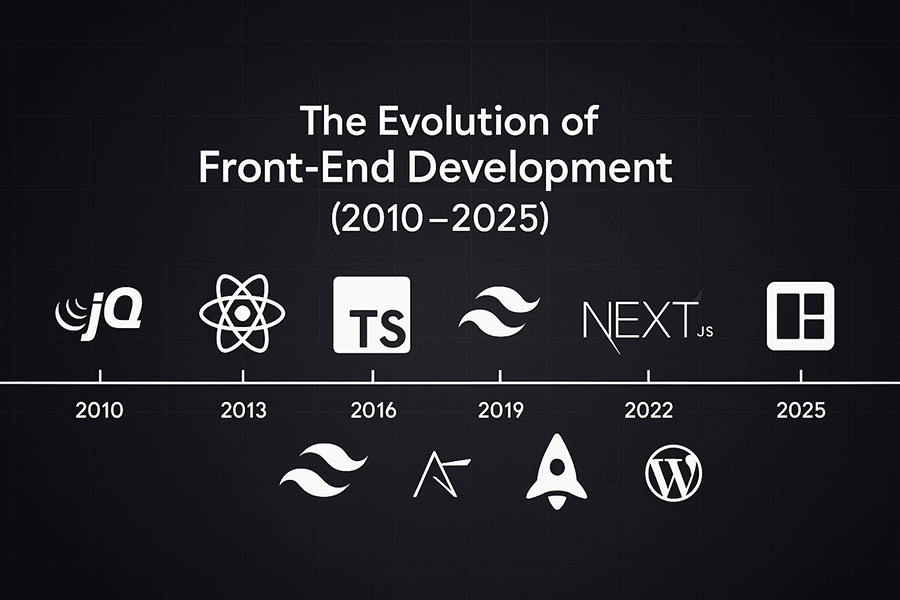
This guide maps the evolution of front-end development over the last 15 years. We moved from jQuery-driven DOM scripts to component ecosystems, server-side rendering at the edge, islands architecture, and powerful modern CSS—often shipping less JavaScript for better UX and SEO. If you want a fast, accessible stack in 2025, understanding this evolution helps you pick the right defaults.
New here? You might also like Emmet tips, CSS features in 2025, and JavaScript Promises.
Evolution of front-end development: timeline at a glance
- 2010–2012: jQuery everywhere; IE quirks; script concatenation; early MVC experiments.
- 2013–2015: SPA era (AngularJS, React, Ember); module loaders (RequireJS); Grunt/Gulp; Bower → npm.
- 2016–2018: Babel + Webpack mature; TypeScript adoption; Redux/state libs; CSS Modules/PostCSS.
- 2019–2021: JAMstack; SSG/ISR; Next.js/Nuxt/Gatsby; design systems; Core Web Vitals.
- 2022–2025: Vite/esbuild; islands/partial hydration; React Server Components; edge rendering; modern CSS (nesting, container queries,
:has(), subgrid).
2010–2012: The jQuery era in the evolution of front-end development
Typical stack: jQuery + plugins, global CSS, concatenated scripts.
<button id="save">Save</button>
<script src="/js/jquery.js"></script>
<script>
  $(function () {
    $('#save').on('click', function () {
      $('#status').text('Saving…');
      // $.ajax({...})
    });
  });
</script>
Why it mattered: jQuery smoothed cross-browser pain and taught a generation the DOM.
Limits: global state, fragile plugins, little structure, and accessibility often an afterthought.
2013–2015: SPAs & component thinking reshape front-end
Shifts: React (components, virtual DOM), AngularJS (data binding), Ember (convention). Build tools emerge; Bower fades; npm wins.
function SaveButton() {
  const [status, setStatus] = React.useState('Ready');
  return <button onClick={() => setStatus('Saving…')}>{status}</button>;
}
Why it mattered: components improved reuse and reasoning; client routing became normal.
Trade-offs: heavy JS bundles, SEO challenges, complex pipelines.
2016–2018: Tooling maturity + TypeScript
Shifts: Babel + Webpack standardize builds; TypeScript improves DX; Redux/Router; CSS Modules, PostCSS, utility CSS spread.
type User = { id: number; name: string };

async function getUser(id: number): Promise<User> {
  const res = await fetch(`/api/users/${id}`);
  if (!res.ok) throw new Error('HTTP ' + res.status);
  return res.json();
}
Why it mattered: predictable builds and safer code across teams.
Trade-offs: config fatigue; steeper onboarding.
2019–2021: JAMstack & hybrid rendering
Shifts: SSG/ISR/SSR hybrids (Next.js, Nuxt, Gatsby); APIs/Functions as services; design systems; Playwright/Cypress; Core Web Vitals guide performance.
# Example Next.js routes
/pages/index.tsx        # SSG
/pages/blog/[slug].tsx  # SSG with ISR
/pages/api/search.ts    # Serverless function
Why it mattered: speed, scalability, and DX improved.
Trade-offs: build times for large sites; nuanced data fetching.
2022–2025: The evolution continues—ship less JS, lean on the platform
Shifts: Vite & esbuild for instant dev; islands architecture and partial hydration (Astro/Qwik); React Server Components; edge rendering; modern CSS removes many JS needs.
/* Container queries + :has() */
.card-grid { container-type: inline-size; }
@container (min-width: 700px) {
  .card { display: grid; grid-template-columns: 2fr 3fr; gap: 1rem; }
}
form:has(:invalid) .submit { opacity: .5; pointer-events: none; }
// React Server Component (concept)
export default async function Article({ slug }) {
  const data = await fetch(`https://api.example.com/articles/${slug}`).then(r => r.json());
  return <main><h1>{data.title}</h1><div dangerouslySetInnerHTML={{__html: data.html}}/></main>;
}
Why it matters: less client JS, better TTFB/LCP, simpler accessibility thanks to native capabilities.
Trade-offs: server boundaries and caching strategy matter more; DX varies by framework.
CSS caught up (so you write less JS)
- Nesting and cascade layers keep styles organized.
- Container queries enable component-level responsiveness.
:has(), subgrid, view transitions, and scroll-driven animations unlock richer UI with fewer libs.- New color functions (
oklch,color-mix,light-dark) make theming sane.
See: CSS features in 2025.
Performance, accessibility, and SEO became table stakes
- Core Web Vitals: budget for LCP, CLS, INP.
- Accessibility: semantics first (
<main>,<nav>,<dialog>,<details>). - Images:
loading="lazy",fetchpriority, responsivesrcset/<picture>. - Routing & data: stream HTML, cache at the edge, prefetch sensibly.
<picture>
  <source type="image/avif" srcset="/img/hero.avif" />
  <img src="/img/hero.jpg" width="1600" height="900" alt="Team collaborating" loading="lazy" fetchpriority="high" />
</picture>
What the evolution of front-end development means for 2025
- The 2010s taught us components and tooling; the 2020s refined where code runs.
- 2025 is about shipping less JS, embracing modern CSS, and choosing the right rendering strategy (SSR/SSG/islands/RSC) per page.
- Start with semantics and performance budgets, then layer interactivity where it matters.
For a semantic refresher, see 10 Must-Use HTML Tags in 2025.
Starter stack for 2025 (opinionated)
- Language: TypeScript
- Framework: Next.js / SvelteKit / Astro (project-dependent)
- Styling: Modern CSS (nesting, container queries) + utility classes or CSS Modules
- Build: Vite (where possible)
- Tests: Playwright (E2E) + Vitest/Jest (unit)
- Content: MDX or headless CMS
- Deploy: Edge-capable platform with caching and image optimization
Further reading (external):
- MDN Web Docs — HTML, CSS, and JS references: https://developer.mozilla.org/
- web.dev — Performance & Core Web Vitals guides: https://web.dev/
Related posts (internal):
Leave a Reply